


Many people dream of becoming a writer but have no idea where to start.
We believe everyone can be a writer. You can be a writer. You just need to discover the right starting point.
In this article, we’ll look at the various steps involved in the process of becoming a writer, including how to start a writing career, how to make a living as a writer, and what it actually means to become a writer.
How to Start a Writing Career
Before you take steps to becoming a writer, the first decision to make is: what type of writer do you want to be?
The different types of writer include:
- Traditionally published fiction author: If you dream of seeing your books on sale in bookshops, this is probably what you’re aiming for.
- Self-published indie fiction author: If you dream of having complete control over your writing career, writing whatever stories you choose and having the final say over how your book is edited, this might be your ideal choice.
- Non-fiction writer: If you’re hoping to tell your life story or impart your expertise in a particular subject, then this applies to you. You can opt for traditional publishing or self-publishing of non-fiction books.
- A single-story writer: If you have one story you’re desperate to share with readers, but intend to hang up your pen afterwards, then you might be best to consider self-publishing. That’s because most literary agents usually prefer to work with career writers, though it will depend on how much market potential your one book carries. If you’re a famous sportsperson, your single memoir will probably attract agent interest!
- A series writer: If you love the idea of writing fiction series, then the option of both traditional and self-publication remains open. However, the type of series you want to write may impact which option is best for you. If you write to a small niche market, self-publication might be the more realistic option.
- A hobby writer: Are you writing for the sole reason that you love it? You don’t need to have aspirations of publication to be a writer.
Once you’ve decided what type of writer you want to be, you’re ready to think about your future writing career.
The following steps apply to anyone who wishes to become a fiction writer, either a self-published or traditionally published author.

Becoming an Author in Twelve Steps
Step One: Develop Your Writing Skills
New writers often believe that if you’ve natural writing talent, all you need to do is sit down, start to write your story, and everything will fall into place.
Romantic myths about writing have been telling us for hundreds of years that this is how we become writers: natural talent, combined with inspiration.
The reality is, this is rarely how writers become successful authors. Hard work and humility are far more important.
Becoming a published author requires dedication, perseverance, a readiness to study craft and listen to feedback, a willingness to improve, a refusal to give up, a deep love of the act of writing, resilience against criticism and rejection, along with skill, talent and a strong dose of good luck.
To become a writer, you first need to sit down and write.
Perhaps you begin with a full novel, perhaps a short story, perhaps a few scenes you hope to weave together later, or perhaps a journal or diary.
It’s highly unlikely the first thing you write will be a masterpiece. Becoming a writer is a great way to develop humility and realism. No matter how intelligent you are, your first attempts at writing will likely carry immense potential for improvement and learning.
It’s important not to become disheartened at this point. As Sherry LeClerc points out in her article, Seven Tips on How to Become a Better Writer, many bestselling authors report similar experiences starting out in their careers.
Good writers never stop learning, developing and growing their skills and knowledge. That’s why becoming a writer is so exciting; there’s limitless potential for growth and improvement on your journey. As long as you’re determined to improve your craft and skills, you’ll never be bored.
There’s no one way to become a good writer. However, there are certain things you can do to help increase your skill and abilities. These include:
- Developing a regular writing practice: Some writers find it helps to write every day; some need days off. Find the method that works for you and allows you to steadily improve your abilities. In general, the more hours you spend on an activity, the greater your competence and proficiency in a skill will grow.
- Taking creative writing courses: Obtaining professional feedback and guidance is one of the most effective ways of becoming a better writer.
- Studying writing craft guides: This is the more affordable option if you can’t afford courses (although you can access unlimited courses with Fictionary for just $29/month). Craft guides can be purchased or borrowed from a library, and provide in-depth dives into particular aspects of writing craft.
- Read free online blogs and watch online webinars: There’s a wealth of free information about the craft of writing online. The Fictionary online community is a great place to start.
- Join writing communities: Not only will many communities offer courses, webinars and blogs, but by making new writing friends you’ll have support through the hard times and the rejections. Moreover, you’ll be able to gain feedback and critiques on your writing for free, and offering feedback in return to your new friends will do wonders for your own writing skills.
- Investigate writing apps: Apps, such as Fictionary, use algorithms and artificial intelligence to provide relevant and actionable feedback on your writing.
- Experiment with free writing: Writing freely without structure or limitations can provide a way to help develop your own voice and story inspirations.
The more time you invest in learning to write well, and the more dedicated you become to your craft, the greater your chances of growing into a professional writer.
Step Two: Read Widely
This is really an integral part of Step One, but it’s so important, it’s worth highlighting this as a separate step.
If you aren’t an avid reader, it’s harder to become a successful writer for a number of reasons, including:
- The more widely you read around newly published books, the more familiar you are with modern publishing and reading trends. This has an impact both in terms of the stories you choose to tell and in terms of the style of prose you adopt.
- Reading widely will help ensure you have a full vocabulary and a great ear for voice.
- Reading other successful authors provides the opportunity for you to study their books so you can see what about their prose and stories makes them popular.
- Reading widely helps you better understand the expectations of modern reading audiences, particularly around specific genre conventions and expectations.
Step Three: Decide on a Genre
This is important: your genre choice will influence how you research, plan, and write your first draft of a novel or entire series.
Failing to decide on a genre is a common mistake for new writers hoping to publish their book. It’s much harder to sell books which fail to meet genre expectations or books that don’t really fall into any easily marketable genre or crossover genre.
Whether you want to be published traditionally or to self-publish, you’ll find it easier to sell your book if it fits within a genre category, as this allows you to market your book towards the appropriate target readers.
Once you know your reader’s genre expectations, it’s far easier to meet those expectations and obtain positive reviews for your book. If you don’t fully understand genre conventions and expectations, you risk ending up with unsatisfied readers and negative reviews.
Step Four: Research
If you’re writing in a genre that requires research, then you’ll need to carry out some degree of this research before writing your first draft, enough to ensure that your plot, characters and setting all work well within the context of your story world.
This is particularly important if you’re writing in genres such as historical fiction, or hard science fiction, in which research is integral to your story world.
If you’re writing in a genre you don’t have particular expertise in, for example, if you’re writing a police procedural or legal thriller without a professional background working in the police or law, then it’s advisable to carry out research before you start to write.
Step Five: Learn the Craft of Storytelling
Writers identify themselves as either planners, planters, or pantsers.
- Planners plan their book in detail before starting to write
- Pantsers sit down to write without a plan, letting inspiration and their characters decide where to take the plot.
- Planters fall somewhere in between the two extremes, planning some elements but leaving others up to flow with the story.
Regardless of which category you identify with, you’ll likely find you write a much better first draft if you possess a decent grasp of storytelling skills and story structure.
You can learn about storytelling structure in a multitude of ways. These include:
- Taking specific courses on story structure. You can find a variety of courses on Story Structure available on the Fictionary online community.
- Studying craft books on Story Structure. Popular books include Save the Cat Writes a Novel by Jessica Brody, The Writer’s Journey by Christopher Vogler, Into the Woods by John Yorke, and Secrets to Editing Success by Fictionary’s K Stanley and L Cooke.
- Joining Fictionary’s online community and chatting with other writers about story structure.
- Reading online blogs on the topic. You could start with this article I wrote on Story Structures, and this article by Randall Gilmore on How to Outline a Novel.
Once you’ve fully integrated these storytelling structures and guidance into your understanding of how to write, you’ll be in a stronger position to either plan or pants your first draft.
Step Six: Write your First Draft
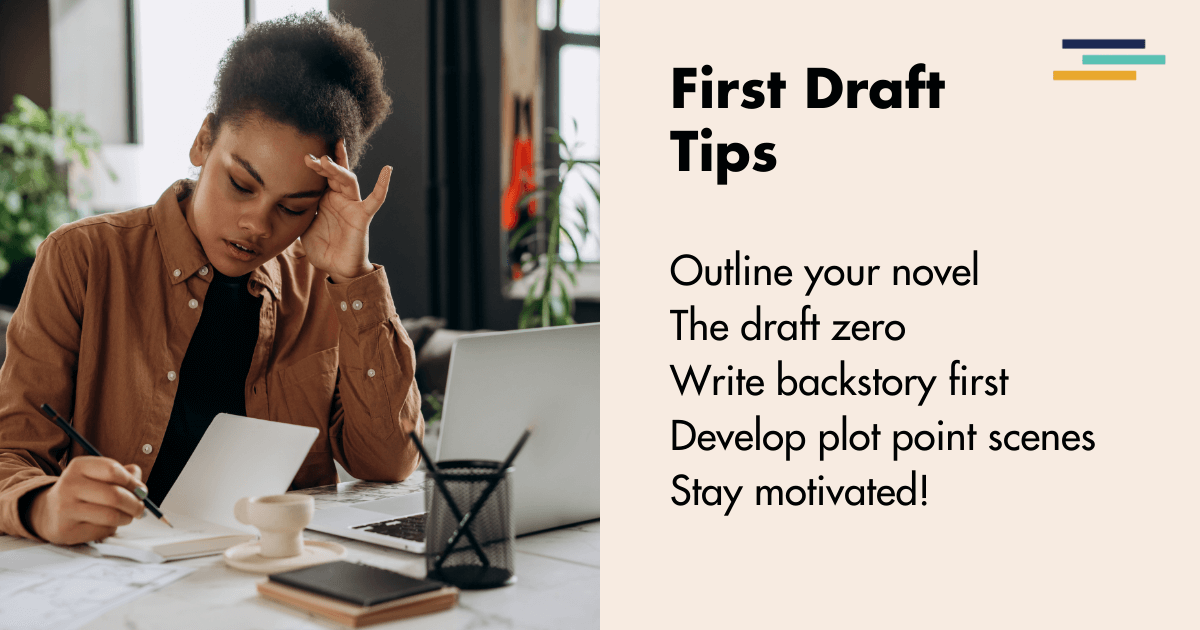
As always, there are limitless ways of approaching this task, and it’s up to you to find your own process. Here are some tips which might help you with this step:
Tip One: Outline your Novel
If you’re a planner, you’ll want to outline your story before starting to write. A great way to learn how to outline your novel in to take Fictionary’s Outline Your Novel course, free to Fictionary’s subscribers.
Tip Two: The Draft Zero
It can help to see your first draft as a purely exploratory draft, a Draft Zero, in which you get to know your characters, plot and setting. With a Draft Zero, you give yourself free rein to explore a variety of different plotlines and character arcs as you write.
This can be a great and fun way to write your first draft, however it’s important to remember that the more you free-write this draft, the more likely it is you’ll need to do some major reworking upon your first structural edit.
Once you’ve accepted this, you can have as much fun as you like with Draft Zero!
Tip Three: Write Backstory Scenes First
It can be helpful to write scenes which may never make it into your final story as a way to get to know your characters: their background, their motivations, what makes them tick.
Again, this type of exploratory writing can be great fun, but it’s important to be ruthless when deciding which scenes make it into your final novel. Not all of these will be story-critical.
Tip Four: Develop Plot Point Scenes
If you’ve already written a detailed plan, with a strong story structure, you might decide to write some of your key plot point scenes first, in order to ensure that your story works around these key scenes.
This can be a really great way to keep your first draft on track as you write, but it’s important to remain flexible, and give yourself the freedom to move away from your plan if you find that character development or plot logic requires this.
Tip Five: Stay Motivated!
Most importantly: keep the faith! Finishing a full first draft can feel overwhelming. It can help to connect with other writers and communities, both in person and online, to keep your motivation levels high as you work through this task. Writing is more fun with friends.
Step Seven: Structurally Edit and Revise Your Draft
Even if you carefully planned out your first draft, there’s a high likelihood that as you wrote, your story may have developed in unexpected ways, or you may have seen stronger story potential by following alternative plotlines, or you may have changed your mind about certain characters and their roles.
A story is a huge entity to hold in your head, and it’s unlikely your plan allowed your story to develop to its fullest potential.
Once you’ve written your first draft, read through the story. Don’t focus on the prose. Focus on the overall story structure.
Look at elements like pacing, tension, goals, conflict, how well different story threads work together, character development, world-building and so on. My earlier blog on how to carry out your own developmental edit provides detailed guidance on this step.
Edit and then revise your story. Try to avoid becoming overly attached to plotlines and characters you may be better off removing.
If you would like some help during this step, you can hire a structural editor. Fictionary has over 20 qualified structural editors who could help you.
Step Eight: Copy Edit your Draft
Once your story structure is solid, look in more detail at your prose, editing for points such as:
- Is your voice/ are your characters’ voices as strong as possible?
- Have you shown dramatic scenes in the best way possible, and told what needs to be told?
- Does your prose flow well and is it readable?
- Are you happy with how you’ve balanced thoughts, narration, action, and description within your scenes?
- Have you removed unhelpful clichés, adverbs and adjectives, and any overused words and phrases?
Step Nine: Proofread your Draft
You’ll need to do another read-through to check spelling, word choice, and grammar, and punctuation. It can help to ask another person to be your second set of eyes here. It’s much easier to catch errors in someone else’s work than it is in your own.
Step Ten: Seek Fedback
At least one professional edit is a must if you’re seeking to self-publish. It’s optional if you’re seeking traditional publication, but may help you obtain representation.
Step Eleven: Finalize your Manuscript
Based on your professional edit and/or beta reader feedback, consider which advice you want to take and how to revise and improve your manuscript.
Step Twelve: Self-publish or Seek Literary Representation
For more on how to do this, see my earlier articles referred to above, How to Publish a Book on Amazon and How to Get a Book Published Traditionally.
How Do You Make a Living Writing?
The general advice is that one should write for love, not money. Making a living either as a self-published or traditionally published author can be challenging.
However, that’s not to say it’s impossible.
How to Make a Living as a Self-Published Author
If you can self-publish successfully, you may end up with greater royalty percentages than if you publish traditionally. Self-publishing a large volume of successful books often presents the best chance of making a good living as a fiction author.
An April 2023 study by the Alliance of Independent Authors found the median earnings for self-published authors was $12,749, almost double that of traditionally-published authors, of $6,080.
To succeed in this area, you’ll need a strong understanding of genre requirements and your target readers.
Successful self-published authors tend to write a lot of series, within genres that sell well in the self-publishing market. Their books are highly-paced and gripping, so much so that readers keep coming back for more.
Books with series may end on cliff-hangers, which encourage readers to buy the next book. As a self-published author, you may choose to publish an entire series at once, to ensure readers desperate to buy your next book are able to do so. If they can’t, there’s a risk they’ll forget about how much they wanted to read the next book in the series by the time it comes out.
To write a successful series, you’ll need an excellent understanding of story structure and pacing. With a strong series, each book has its own complete story arc, and yet the series itself will also need overarching story and character arcs.
The main requirement for making a living as a self-published author is to write a large volume of high-quality books. One way to help you quickly analyze the quality of your pacing and story arc is through a Fictionary subscription.
Fictionary provides a structure to help writers self-edit their stories quickly and effectively, analysing their manuscript against 38 objective story elements which combine to help you create a strong story. Any tool which enables you to write and publish a large number of gripping novels will increase your odds of becoming a successful self-published author.
How to Make a Living as a Traditional Author
Given the smaller royalties traditionally-published authors receive, many traditionally-published authors still choose to supplement their income through other ways, such as teaching creative writing, or mentoring new writers.
To make a living as a traditional author, your books must sell really well.
Your prospects will increase as you develop your understanding of genre requirements, and the types of stories and writing styles modern readers seek.
The Bestseller Code by Jodie Archer and Matthew L Jockers is a great place to start researching the ingredients of a bestselling book.
If you’d like a writing tool that helps you incorporate the key aspects of pacing and character development into your story, then Fictionary provides an ideal solution. Fictionary features tools including algorithms, artificial intelligence, and self-editing assistance to help you assess how well your story compares with bestsellers.
How to Become a Successful Writer
Becoming a successful writer is about more than just making a decent income. At the deepest level, becoming a successful writer means writing high-quality books you love and are proud of. After that, if those books are read and loved by others, that adds a valuable layer to the experience of becoming a successful writer.
At the end of the day, becoming a successful writer is about writing great books.
And since few first drafts are masterpieces, writing great books requires you to develop skills in editing and revising, along with the persistence and dedication to rewrite as much as necessary until each draft becomes a great book.
Even if your first great book doesn’t become a bestseller, for as long as you keep learning and writing, your prospects of success increase.
Perhaps you’ll write a second or third or fourteenth book that meets market demand. Or perhaps one of your books will be strong enough to bend market forces around its gravity. If you give up at the first hurdle, however, you’ll never become a successful writer.
How to Be A Writer: Conclusion
In order to be a writer, you need to write. Once you put pen to paper, or finger to keyboard, and start turning your imagined stories into writing, you become a writer.
The key is to not give up, to take every learning opportunity you can, and to enjoy yourself in the process. If you’re looking for fellowship on this journey, come join the online Fictionary community, where learning opportunities and potential new friendships abound.