


Amazon KDP (Kindle Direct Publishing) is Amazon’s free publishing platform, which allows authors to self-publish their books on Amazon.
The platform can make your books available in both e-book format for kindle and paperback.
Amazon KDP is free to use (although once you start making book sales, Amazon will take a percentage of your revenue).
What is Amazon KDP?
Amazon KDP is designed to be user-friendly for authors self-publishing for the first time.
It’s ideal for:
- Authors who don’t wish to work with a traditional publishing house, or who don’t want the hassle and uncertainty of submitting their book to agents and publishers.
- Authors who write in certain niche genres, which often sell better in the indie e-book market than in hard copies in bookstores.
- Authors who can write a large number of books and prefer to be in charge of their own editing, rights, covers, marketing, advertising and so on, and who are looking to be in charge of their sales and profits in order to generate more income themselves.
- Authors who want to publish just one book, and aren’t looking to make a writing career for themselves.
The types of book you can publish on Amazon KDP include:
- Novels
- Book series
- Textbooks
- Children’s books
- Poetry
- Cookbooks
- Comics
- Puzzlebooks
Once you have an author account on Amazon KDP, you can publish as many books as you want on the platform. You can publish under your own name or a pen name, or a variety of different names, the choice is yours.
You can buy your book in paperback versions to sell yourself, or to give away as you choose.
Amazon KDP makes your books available to Amazon’s huge worldwide audience, as long as you own the rights to your book in each country where it’s sold. (Although in certain countries, your book must be enrolled in KDP Select in order to be sold.)
Your books will receive a sales ranking on the Kindle store, which means that if your book is successful, it will become more visible to potential readers and buyers.
Amazon has various marketing and advertising tools which you can use to help make your book more visible to your target readers.
You also have differing options in terms of how much of your revenue you give to Amazon, depending on the price of your book and whether you choose to make your book available through Kindle Unlimited.

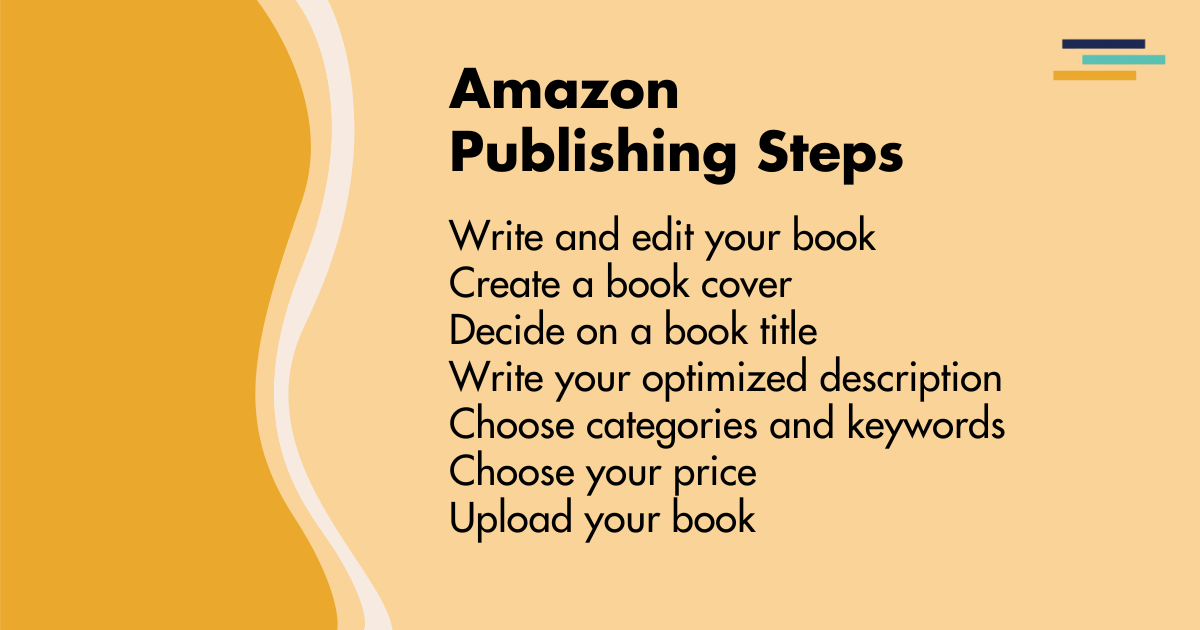
Amazon Publishing Steps
Step One: Write Your Book
This is the obvious first step. Check out my article for ideas on how to get started writing your book.
If you’re hoping to create a profitable business as a self-published indie author, then it’s well worth carrying out substantial research on the types of genres and books which sell well in the indie e-book world. Certain specific niche genres sell particularly well in e-book versions. These include genres which have a substantial fan-base keen to read as many of these stories as they can, but without the wider market appeal to sell strongly in bookstores.
So, for example, a modern psychological thriller can sell well in bookstores, and if your thriller has sufficient commercial appeal and is strongly written and structured, you might attract the interest of literary agents or publishing houses.
Whereas a Viking romance may be harder to sell to a wide market, meaning it’s less likely to attract interest from a publishing house, but could still generate strong sales profits from e-books if you’re able to attract dedicated readers of Viking romance novels. These are the readers who actively search for Viking romance novels on Amazon, and may be ready to give new authors a try, if your book cover and blurb appeals.
If you’re hoping to become a successful independent author, researching these niche genres, reading extensively around the most successful indie books in the genre, will help you write a book with commercial potential for the self-publishing market.
Step Two: Edit Your Book
You should always first self-edit your book, whether you’re hoping to publish traditionally or self-publish on Amazon.
If you’re planning to publish on Amazon KDP, I’d strongly advise you to also obtain at least one professional edit from an independent editor.
A professional editor will be able to see objective weaknesses in your story which you can’t, being too close to the story yourself.
If you’re looking to be a successful author, you need to write great books. And great books, more often than not, are a product of teamwork between authors and editors.
Ideally, you should first obtain a structural story edit, which analyses the flow of your story and how well the story holds together. If don’t know how or where to look for a story editor, check out my article on How to Find a Story Editor, as well as the Fictionary Community, where you can meet editors trained to carry out structural edits.
The next step is to obtain a copy edit, which looks at the flow of your prose and quality of your writing.
The final step is to obtain a professional proof-read, checking for spelling and grammatical mistakes. You don’t want a proof-reader who will automatically correct your grammatical mistakes, as these may be integral to your character’s voice – but you do want to be aware of what mistakes exist in your prose, so you can make an informed decision as to whether you change or keep them.
Step Three: Create Your Book Cover
Amazon KDP provides tools to help you create your book covers.
You may choose to create your book cover using these tools, or you might choose an alternative platform, such as BookBolt, Coverjig, Canva, Krita etc.
You need to have your book cover ready before you publish your book on KDP.
It’s worth researching the book cover styles common to successful indie e-books in your genre – the right cover should help attract the right readers.
Step Four: Decide on a Book Title
If you plan to write in multiple genres, it can be helpful to use a different pen-name for each genre, to prevent reader confusion. If your sweet high-school romance reader accidentally picks up your grisly slasher horror book, they may give you bad reviews and be turned off your future books entirely.
Step Five: Write Your Optimized Description
This is where your earlier genre research will once again pay off. As you read widely around the popular books in your genre, you hopefully familiarised yourself with their book descriptions on Amazon. (If you didn’t, then go back and do this before writing your own!) It can also be worthwhile researching books that haven’t sold so well, so you can compare the difference in their book descriptions.
At Fictionary, we recommend making strong use of your book blurb in your book description. At the core of your book blurb you want to make clear that your book has:
- A protagonist: ideally one relatable to your target readers.
- A story goal: something your protagonist will work to achieve throughout the story.
- Strong story stakes: real consequences if your protagonist fails to reach their goal.
A strong book description should also include a hook. That is, a line which draws the reader into the story.
As much as possible, make your book description immersive by using strong verbs and sensory images, but don’t go overboard, and avoid using too many adjectives and adverbs. Carefully analyse the words most often found in successful book descriptions in your genre, to give you an idea of the sort of description to write.
You want to ensure the reader has a strong idea about the story’s central conflict by the end of the description, as this will ensure the right readers buy your book.
It’s often worth ending your book description with a question, which encourages the reader to buy the book so they can discover how the story ends.
To maximise your sales, learn about the importance of metadata for promotion and marketing.
Step Six: Choose Categories and Keywords
This is an art in itself, so I’d recommend researching categories and keywords widely.
Step Seven: Choose Price and Royalty Percentage
The price you choose will affect the royalties you receive.
If your e-book is priced between $2.99 and $9.99, you’ve the option of receiving 70% of the royalties on your book.
- You’ll need to pay a distribution fee on each book you sell, which varies depending on the digital file size – Amazon has a fee calculator available on their site.
- To gain 70% royalties, your e-book must cost at least 20% less than the paperback version.
- You must own the copyright to your book in all countries where its sold.
- And in certain countries (Brazil, Japan, Mexico and India), your book must be enrolled in KDP Select to receive 70% royalties.
- A paperback book will usually receive around 60% royalties, but this depends on the production costs for the book.
If your book is less than $2.99 or more than $9.99 you can only receive 35% royalties. If your book has a large file size, this option might make financial sense.
After taking this into account, you want to investigate the price of other successful books in your genre, and carry out some research as to what price level tends to draw your target readers.
- Does your genre often attract readers who want to pay only a small amount for their e-books? If you write in a genre where novellas and short novels are most popular, readers may prefer cheap, fast reads.
- Will your target readers be put off by a cheap price, believing your book worth less than a more expensive book?
- Can you actually make a sufficient income if you set your price too low?
Step Eight: Consider Enrolling in KDP
KDP Select is only available for e-books, not paperbacks.
KDP Select is free to sign up for, and gives you the opportunity to reach more readers through access to additional promotional tools, including time-limited discounts and free book promotions.
Your book will be available on Kindle Unlimited. This means you won’t be paid the usual royalty fee for books read through this program, but rather you’ll be paid per page that a customer reads from your book. This can be a good choice if you’re confident you’ve written the type of book popular with Kindle Unlimited readers, and if your book contains a gripping, page-turning story readers can’t put down.
For new authors keen to get their books in front of readers, and to obtain as many reviews as possible, Kindle Unlimited can be a good option.
As always, if you’re unsure whether your book is the type to be successful on Kindle Unlimited, carry out research. Subscribe, and read the most popular books available.
Step Nine: Read the KDP Content Guidelines
If you breach these content guidelines, your book may be rejected or removed.
Step Ten: Upload Your Book
If you’d like step-by-step guidance for the technical side of this, check out the guidance provided by Amazon. JungleScout also provides some useful guidance.
Tips For Amazon Self Publishing
Tip One: Write A Great Book
Successful self-published authors make impressive income streams through prolific publishing. To self-publish a large number of high-quality, page-turning books which keep readers coming back for more, it’s helpful to have tools at your disposal.
One of these tools is Fictionary Storyteller.
To be successful in the self-publishing industry, you need to understand how to write a gripping page-turner. This will increase your odds of gaining new readers, particularly as:
- A gripping story will give you the best chance of writing a strong book description and hooking readers in.
- A well-paced novel will increase the number of pages that new readers read on Kindle Unlimited, should you choose this option.
- A strong story will improve your reviews and bring in more readers.
- A page-turning start to your story will bring in readers who choose to read the first ten percent of your story for free, and lead to more book sales.
- The more you understand what a story is made of, the better your chances of repeating your initial success in future books.
- The more gripping novels you can write, the more dedicated your fan-base will become, and the better your chances that readers will stick with you and buy future stories.
- The deeper your comprehension of story structure, the quicker you’ll be able to write strong stories, and the faster you’ll increase your income.
Fictionary Storyteller is designed to teach writers the key elements of strong story structure and help them structurally edit their drafts into commercially viable novels.
Storyteller breaks down your manuscript into smaller units which you can then edit according to the 38 Story Elements, ensuring each scene has strong conflict, tension, goals, immersive descriptions, relevant action, emotional development and so on.
Optional Artificial Intelligence features read your scenes and analyse their strengths and weaknesses, allowing you a more objective view into which scenes are strong and which require revision.
With Storyteller, you can gain a more objective perspective on your story and easily set out your revision plans as you edit your manuscript into a stronger story. By providing you with structural guidelines for editing, you can be more efficient and effective in your story editing.
Tip Two: Don’tViolate Amazon’s Terms
You don’t want Amazon to pull your book because you’ve infringed their terms of service. I recommend reading and familiarising yourself with these terms before investing time and effort and money into self-publishing your book.
Tip Three: Learn How to Market
Unless you’ve a professional background in marketing and advertising, it’s worthwhile learning how to give your book the best chance of success through strong marketing and advertising.
Multiple resources are available online for studying up on self-published book advertising.
There are courses available which cost money, but also myriad free resources.
One place you can search for free resources is the online Fictionary community, where free self-publishing webinars take place. You can also meet and connect with other self-published writers, so you can learn from them about which successful strategies they’ve employed.
Tip Four: Get Book Reviews
Advanced reader copies (ARC) are sent out to independent readers before your book is published. In return for free book copies, the readers will review your book online, so that on the day your book is published, you’ll have reader reviews available on Amazon.
Amazon will know if you’ve just sent copies to your friends and family to get good reviews, and will likely remove these reviews from your page. However, ARC readers – whom you should have no prior connection to – will write independent and trustworthy reviews which, if positive, should help you sell your book.
Of course, the best way to ensure positive reviews is to write the best book possible. Back to Tip One for that!
How to Self Publish on Amazon Conclusion
Many writers decide they’d rather self-publish their books than seek traditional publication, for a variety of reasons.
Amazon KDP helps make self-publishing simple and straightforward for new authors.
To give yourself the best chance of publishing a story you’ll be proud of, and which will draw in readers and positive reviews, learn as much as possible about how to write a great story, how to market your book effectively, and you’ll be well on your way towards turning this dream into reality.