


Do you struggle with how to write your characters’ thoughts?
I know I do!
See what I did there? I modeled one very simple way to format thought as you write your stories—with italicized text. Now, if only that’s all there is to it.
This could be a very short blog post, and a cinch to write!
But, of course, there’s more. That’s because the thoughts of our characters are their personal reflections and subtle self-talk moments. We count on them to add depth to our characters and to engage readers in our characters’ emotional journeys. This translates into a measure of intimacy for our readers. Our characters become round to them, real even, as we let them into their private, unspoken thoughts.
Thus, including our characters’ thoughts is a fundamental part of our craft and essential to good storytelling.
Let’s examine various approaches to writing thoughts in a story. After that, we’ll look at the steps to apply these consistently. I’ll wrap up at the end with tips to ensure that your characters’ thoughts will feel like a natural part of your story.
How to Show Thoughts in Writing
We can portray a character’s thoughts through various common methods. Here are five options:
In Italics for Internal Thoughts
Use italics to set apart a character’s inner thoughts from other parts of a story, such as spoken dialogue and narration.
Italics provide a strong visual cue to readers. They set apart a character’s inner thoughts from other parts of the story, such as dialogue or narration. They signal entry into a character’s mental space.The visual break supplied by italicized text marks the shift. For instance:
‘Sherri turned and looked out the window at the mile-long driveway leading from her house to the main highway. What if he doesn’t come back?’
Using italics is especially useful for thoughts that the character “hears” internally, like when they’re giving themselves advice or reflecting on something important.
In Plain Text with Narrative Tags
Another approach is to present thoughts in plain text, accompanied by a narrative tag like “he thought” or “she wondered.” This method can be a subtle, clean way to incorporate thoughts without breaking the flow of the story. For example:
‘She wondered if he would ever return.’
The freedom to not use italics allows for variety and nuance. Narrative tags like “thought,” “wondered,” or “considered” can do the same work and show that a character is thinking. They also maintain the flow of description and action. The story moves forward without calling extra attention to the thought.
Tagging also works well in third-person narratives. The thoughts of characters remain part of the fabric of the story, while aligning with the voice of the narrator.
Tagging is also well-suited for three other types of writing thoughts. The first is levels of internal processing. Consider this example: “She wondered if he’d really meant what he said, then realized with a sigh that she would probably never know.” Levels of internal processing shown in this way feel normal. There is no concern raised about the mental state of the character. If that were the goal, the italicized text might be the better vehicle to show it.
The second is in past-tense storytelling. Thoughts occurring in the past can sometimes create a jarring effect when rendered in present tense. Plain text plus a tag lets writers maintain past tense in the thought without breaking immersion. For example, “He wondered if he’d made the right choice” keeps the narrative tense consistent, while reminding readers that the thought occurred in the story’s past timeline.
The third scenario is when a character’s thoughts and actions are meant to flow seamlessly. Consider this example: “He picked up the letter, wondering if this was the right decision, then tucked it in his pocket.” The “he thought” feels natural, and captures both the thought and the action.
In First-Person as Interior Monologue
An interior monologue is a form of self-talk. It is written in the first person. In this approach, a character speaks to herself about her thoughts and feelings. The writer delves into the character’s mind in their own voice, as if characters are narrating their own story at the moment. We witness their dilemmas and emotions. We see how they justify themselves. The result is an intimate look into a character’s mental state. The character’s inner voice takes over and they tell their own story. For instance:
‘I’ll never understand why he left. What did I do wrong?’
This method immerses readers in the internal dialogue of characters and helps them to stay close.
As Dialogue in Quotation Marks (for Direct Thoughts)
Some writers prefer to write thoughts in quotation marks, similar to spoken dialogue. This approach gives any thought expressed a sense of weight, that the thought feels big or special. It stands out as a key idea or a strong feeling that the character has at that moment. For example:
‘“What am I going to do now?” she thought, panic already creeping into her mind.’
Using quotation marks around thoughts treats those thoughts like spoken words. It’s like saying, “This thought really matters” or “This is a serious moment and has a major impact on the story.”
Without Tags or Special Formatting
For a more subtle approach, writers may choose not to use tags, italics, or quotation marks to mark thoughts. For instance:
‘He looked at the empty chair, the weight of regret settling over him. He’d never get another chance to say goodbye.’
This approach has the effect of blurring the line between narration and thought, which can make emotional scenes feel genuine and immersive. It draws readers in and gives them a chance to “live” the same experience the character is living. All without breaking the pace of the story.

How to Write a Thought in a Story
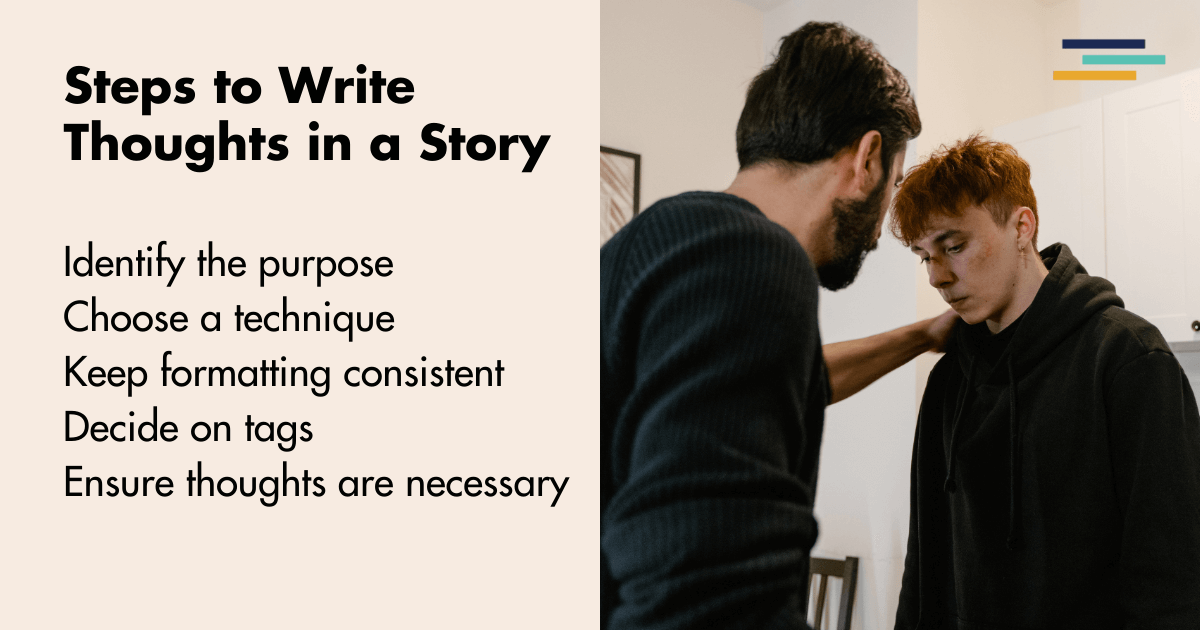
No matter which technique you choose to convey thoughts, there are steps you can take to ensure your approach is effective and consistent. Let’s break down the general process:
Step 1: Identify the Purpose of the Thought
Consider why you’re including the thought. Is it to reveal something about the character’s past? To foreshadow an event? Or provide insight into their personality? The purpose will guide how you write and format the thought, helping you select the technique that best matches the tone and function.
Step 2: Choose a Technique Consistent with Your Story’s Style
Match the method for showing thoughts to your story’s overall style and voice. Is your story heavy on introspection? Use italics.
Interior monologue also works well with introspection.
Is your story heavy on fast-paced action scenes? Use direct thoughts in quotation marks for a punchier effect.
Step 3: Keep Formatting Consistent Across the Story
Consistency is key. Choose a technique and stick with it. It’s important for readers to know when a character is thinking or when it’s just regular narration. Switching can confuse readers and disrupt the flow. Staying consistent clarifies what is thought and what is not, and keeps them in the story.
This is where Fictionary StoryTeller can help you track these stylistic choices, so you don’t have to worry about breaking consistency as you self-edit. Fictionary StoryTeller is software that helps writers through every stage of their writing journey, from the first outline to the final revision. Follow this link for more information: https://temp-fictionary.flywheelstaging.com/products/storyteller/
Step 4: Decide on Tags and Tenses
Do you want to include tags like “she thought” or “he considered”? Think about whether tags add clarity or if they’re unnecessary for your chosen style. Similarly, keep an eye on tense. A consistent tense keeps the narrative smooth and readable.
Step 5: Ensure Thoughts Add to the Story’s Depth
Every thought should reveal something important. Aim to use each to add depth to a character or to move the plot forward. Avoid using thoughts that merely restate information readers already know, as this can slow the pacing.
How to Show Thoughts in Writing Example
Let’s look at more examples of how each of these methods can appear on the page.
Example Using Italics
In Life of Pi by Yann Martel, Pi’s thoughts are often expressed in italics to show his internal reflections:
‘I will not die. I refuse it. I will make it through this nightmare.’
In this scene, the italics help readers enter Pi’s mind. We feel his determination and resolve. It’s a powerful way to show his inner strength without needing tags like “he thought,” making the moment feel immediate and intense.
Example Using Plain Text with Narrative Tags
In The Hunger Games by Suzanne Collins, Katniss’ thoughts are often presented in plain text with narrative tags. Here’s an example:
‘I wonder if she will enjoy watching me die, I think bitterly, glancing at the cameras.’
Collins uses the narrative tag “I think” to make it clear that Katniss is reflecting internally. There’s no need for italics or quotation marks. The tag blends Katniss’ thought with the narration and keeps the thought as a natural part of the storytelling style.
This approach keeps readers close to Katniss’s perspective without breaking the flow.
Example Using First-Person Interior Monologue
In The Magician’s Nephew by C.S. Lewis, Digory reflects on his thoughts in a personal, first-person way:
‘“It’s not fair,” thought Digory. “I didn’t ask to be dragged into this whole mess.”’
Lewis shows Digory’s thoughts as if Digory is talking to himself. His approach helps readers feel like they are inside Digory’s mind. They feel as though they are sharing his frustration as he tries to understand what’s happening to him.
Example Using Quotation Marks for Direct Thoughts
In A Series of Unfortunate Events by Lemony Snicket, quotation marks are used to show the children’s thoughts:
‘“What will we do now?” Violet thought, her mind racing with possible plans.’
Quotation marks help readers to feel the intensity of this moment. They portray Violet’s thought as though she is speaking out loud to herself as she scrambles to find a solution. This gives her thought an urgent and direct feeling.
Example Without Tags or Special Formatting
In Pride and Prejudice, Jane Austen often reveals Elizabeth’s thoughts without using tags or special formatting:
‘Elizabeth was determined to make sure her feelings were in no danger of falling for Mr. Darcy. She could never marry someone so proud and disagreeable.’
The lack of tags or formatting makes Darcy’s thought blend naturally with the prose. Her thoughts about Darcy simply mix into the story. There’s no “she thought” or italics. This helps readers understand her feelings without interrupting the story. Her thoughts feel natural, like they’re simply part of who she is, fitting smoothly into the way the story is told.
How to Format Thoughts in Writing Tips
Here are some quick formatting tips to ensure your characters’ thoughts are clear and consistent:
- Choose a single format for each type of thought (e.g., italics for internal, quotation marks for direct).
- Use quotation marks for thoughts sparingly to avoid confusing them with spoken dialogue.
- Be consistent with tags. If you include “he thought” or “she wondered,” use them regularly or skip them entirely for a seamless style.
- Italicize sparingly—overuse can tire the reader’s eyes.
- Avoid overusing direct thoughts in tense scenes. They can slow down pacing if not carefully balanced.
- Pay attention to tense and perspective. Keep thoughts in the same tense as the narrative for a smoother flow.
- Use Fictionary StoryTeller to keep track of stylistic choices, making it easier to maintain consistency during revisions.
Capturing a character’s thoughts is essential for creating depth and connection. By following these techniques and tips, you’ll have all the tools you need to write the thoughts of your characters and bring your story to life.
This guide has shared five ways to show thoughts in a story. Each way helps show what your character is thinking and feeling. You can use italics, add tags like “she thought,” write in first-person, use quotation marks, or blend thoughts into the story. Each method has its own strengths. The one you pick can help set the mood for your character’s journey. Remember, your goal is to let readers “hear” the character’s inner voice in a way that feels natural and enhances the story. When readers can see inside your character’s mind, they will better understand their feelings and what they’re going through.
Don’t be afraid to experiment and find what fits your style. With a clear approach and a bit of practice, you’ll create characters whose thoughts feel as real and engaging as their actions. So dive in, explore, and start writing those moments that make your characters come alive.
You’ve got this!