

Like it or not, we live in a world where most new authors just can’t afford to skip having their own website.
Whether you’re a traditionally published author, self-published author, or an aspiring author, creating a strong website is a valuable step towards establishing your presence in the publishing world.
In this article, we’ll look at what makes a great author website, some examples of the best author websites out there, and some tips for how to start building your own website.
I won’t be looking at the technological aspects of website-building such as coding and selecting hosts.
What Makes a Great Author Website For Published Authors?
There’s no one way to design the perfect author website, but there are certain key elements you’ll probably want your website to include. These elements vary depending on whether you’re a published writer yet or not.
If you’ve already published books, these are the elements you should look at including in your website:
A Picture of You
Your author website provides the opportunity for you to start building a connection with your readers, and for this reason it’s generally a good idea to include a picture of yourself on your website.
Readers who enjoy your books may be keen to get to know you as a person, and it’s easier to do this if they can visualise you.
A Brief Bio
As above, this is your chance to introduce yourself to your readers, and encourage them to get to know you, so they start feeling connected and committed to you and your books.
You can either include a brief, 3rd person professional bio; or a longer, more personal first-person introduction, or both. Think about what type of readers you want to attract, and whether they’d prefer a bio that’s more detached or more intimate.
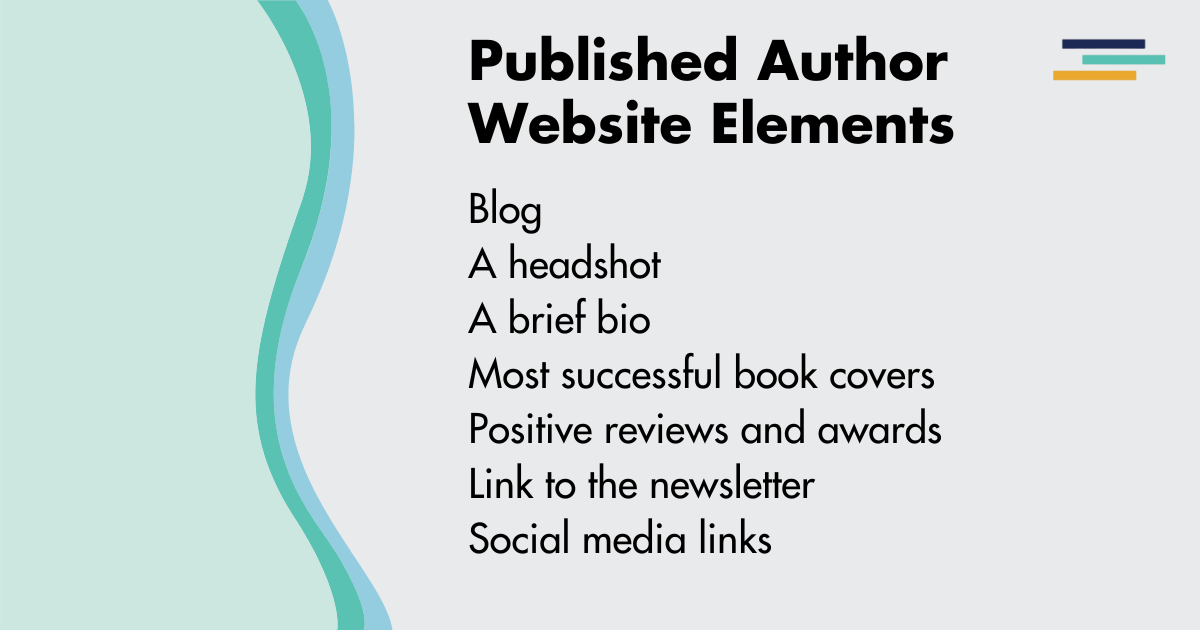
Your Most Recent or Most Successful Book Covers
In general, you’ll want your books to take centre stage on your website, as your main purpose in creating this website is usually to sell books.
There are exceptions, of course. Colleen Hoover’s website, for example, prominently features merchandise surrounding her books: Lily Bloom t-shirts and scented candles, for example. James Clear runs a popular newsletter and Atomic Habits app, and so his website features prominent links to sign up for these.
However, these are the exception to the rule, and most successful authors ensure their book covers take centre stage in their websites.
You’ll want to include e-commerce links attached to your book covers, so readers can easily click on the book to be taken to various sites for purchase: Amazon, Barnes & Noble, Waterstones, etc.
Positive Reviews, Awards and Achievements
If you’ve won a literary prize, topped the New York Times Bestseller list, or been given a glowing endorsement by a respected reviewer, you’ll want to ensure this is one of the first things to catch a reader’s eye on your website.
People are more likely to place enough trust in you to purchase your books if they see other people have valued your work.
Link to Your Newsletter/Blog
One of the best ways to sell your books is through a strong newsletter presence.
If you can make direct contact with your readers on a regular basis, you’ll be in a better position to sell your new and old books to them.
Not only will they be aware of, and get excited about, your new projects, but by continually reminding them of your books’ existence, they’ll be more likely to think of you as they search for new books to buy, and may opt to buy one of your older books that they haven’t yet read.
If you write a regular blog, you want to encourage website visitors to sign up to receive this when it’s released, so they’re kept updated about your new projects.
One way to encourage readers to sign up for your newsletter/ blog is to offer something free as a thank you for signing up – perhaps a free short story about one of your book characters or world, or a short prequel novella. If you keep giving out free stories to your subscribers, they’ll be less likely to hit unsubscribe when their email inboxes are overflowing.
Link to Your Social Media Pages
Not all authors have social media presence, but this is another great opportunity to build connections and relationships with your readers and potential readers.
Social media can be a valuable way to help you find your tribe, as long as you can manage to not let the trolls bring you down!
Websites for Unpublished Authors
Although it’s valuable for a writer to set up their website prior to publication, it can be tricky to know what to include at this point. Some elements to consider including are:
Your Photograph and Bio
It’s great to get this established as soon as possible on your author website. If you’re unpublished, the more creative and engaging you can be on this, the better, as it’s a way to get potential readers interested in you before your first book is out. If you’ve won any awards, or are represented by an agent or signed by a publisher, mention them here.
Your Newsletter/ Blog
Although your newsletter will likely have only a small subscription count at this point, if you regularly send out engaging and interesting updates, you’ll be showcasing your writing skills to potential buyers of your books when they are published.
Links to Your Social Media Pages
As above, active engagement with readers and authors on social media can be a great way for you to start finding your tribe early.

Links to Any Publications
If you’ve had any short stories or articles published, or you’ve written blogs elsewhere which might interest your readers, you can include these here.
Links to Any Writing Communities You’re Involved With
Many unpublished authors actively engage with online writing communities. Hopefully, these activities will direct some potential readers to your website.
But it’s worthwhile ensuring that this works in reverse, too – any writers or readers coming across your website might be keen to engage with you on these communities, or check out any stories you’ve posted there.
A Summary of Current Projects
This is optional, but you may wish to update website visitors about any up-and-coming projects of yours. If you’ve signed a publishing deal and your first book is already in production, then you’ll want visitors to grow interested in purchasing your book.
If you’re preparing to self-publish a series, then you might also want to let potential readers know when the books will be available.
You should only list projects that you’re certain will be published, however. If you list projects that never come to fruition, you risk looking unprofessional.
Best Author Website Examples
Let’s take a look at how some of the best author websites have been designed.
Dan Brown: Official Website
At the time of writing (April 2025), Dan Brown’s website opens with a link to pre-order his newest novel, The Secret of Secrets.
There’s a link to Dan discussing his new book on Good Morning America, and a link to the book description. Given his new book is a new Robert Langdon book, this will be a real enticement to any DaVinci Code fans to start getting excited.
There’s an ‘About’ page with a photograph and three-paragraph professional bio of the author, followed by Press Kit Links.
Another page sets out all his novels (the most successful ones first), with links to purchase these books.
Another page sets out the various film and television shows of his stories, with trailers easily accessible for each.
There’s a ‘More’ page, with links to Dan’s online Masterclass, the DaVinci Code stage play, Dan’s Planetarium show, his Picturebook for young readers, and Guides to his novels designed for Book Clubs and Reading Groups.
Finally, there’s a ‘News’ Page, with links to various news articles and press releases about Dan’s work, with an Archives section at the end.
This author website is slick, professional, and fulfils many of the tasks of an author website. Given Dan’s huge success as a writer, he’s no need to write out long, personal bios about himself. Readers flock to his work without needing him to have a social media presence or newsletter to remind them he exists.
The website works brilliantly to entice reader curiosity about his upcoming book release, and to show readers Dan’s an author they can trust to write stories they’ll love.
Julia Quinn
At the time of writing, Julia Quinn’s website opens with a huge banner advertising the upcoming season of Bridgerton on Netflix, and a picture of the book the show is based upon. Since a large number of her new readers will be devotees of the Netflix show, this is a sensible way to introduce her website.
This is followed by images of some of her Bridgerton series book covers, (the newest covers based upon the Netflix show, not the old covers which preceded the show), with links to read, buy and listen. There’s a link to buy special edition volume sets of the series, and a picture of the author.
As you scroll down, we learn about Julia’s charity work and the links to this work on Facebook. This comprises a large section, ending with a quote from Julia herself: “In some ways, portraying a healthy relationship in literature is the most revolutionary thing you can do.”
This is a brilliant way for Julia to attract her tribe of readers through her website.
As a romance writer, she attracts readers who care about love and relationships, and by showing that she’s actively engaged in making the world a better place through her charity work, she comes across as someone who’s genuine and trustworthy.
Website visitors understand that Julia’s stories are intended to be uplifting and inspiring, rather than dark and brooding.
Her website is perfectly targeted to appeal to her ideal readers; the one who will value and enjoy the stories she tells.
There’s a detailed Bio page, which includes both an official, professional short bio and a much longer, chattier and friendlier write up, ‘How JQ Became a Writer’. This is a great way for Julia to connect with readers, and for website visitors to get to know her writing style and voice. There’s a Media Kit, links to articles, and more links to her books.
There’s another section specific to her Queen Charlotte books and the Netflix show.
Another page features Bonus materials such as essays, soundtracks, deleted scenes, and graphics for social media, no shortage of fun extras for fans to sink their teeth into.
Another page featuring ‘Events’ has links to talks given by Julia, and Romance and Regency events taking place around the world.
The next page, ‘JQ Around the World,’ has links to foreign language editions of her books.
A sign-up page allows you to sign up for JQ’s newsletter, and you’ve the option to receive big news only, or more regular updates.
The final page offers a hugely extensive Q and A section, all about Julia and her books.
In summary, Julia Quinn’s website offers a masterclass in tailoring one’s website perfectly to one’s target readers.
Tips for Building an Author Website
Focus on Branding
Building up an author website is a great opportunity to start developing your author brand. Dan Brown does this with his own logo and a gold and black colour scheme that’s slim-lined, simple and suggestive of the spiritual elements of mathematics through the triangulation of the A in his name, something DaVinci Code fans can appreciate.
Julia Quinn brings out her romance author branding with a champagne and pink colour scheme, flowing cursive text, and the friendly reference to herself as JQ.
You can gain a great sense of what these authors’ books will be like through their author branding.
Update and Improve
Don’t ever think of your website as a finished product. As you should be continually refining and improving your own writing style and abilities, so should your website mirror your own development as an author as you learn, grow, publish more and attract yet more readers!
Consider Finances
If you’re an unpublished author, it can be tempting to spend as little as possible on your website, seeking out a free host if possible. However, be aware that you may find it harder to grow and develop on these websites.
Cheaper websites are often more at risk of crashing regularly. One key point to remember is that you can rarely add e-commerce links to free website hosts, and this will be important once you’ve published your first book.
It’s up to you how much money you have and are willing to invest at this stage, but be aware you may find yourself growing out of the cheapest website options.
Conclusion
Author websites provide a unique opportunity for you to showcase your talents as a writer, and to engage readers.
Whilst the technicalities of building a website can seem daunting for many writers, once you’ve learnt the basics, think of this as an opportunity for creativity, fun and connection.