


You’ve heard of the three-act structure. It is what most of us are taught in school. You might have even heard of the four-act structure where you take the double long middle act and break it in half. Some of you may have even heard of the two-act structure which is popular in Eastern literature. But have you heard of the five-act structure?
There is some debate on the origin of the five-act structure. Whether you are a fan of the theory it was Aristotle, Shakespeare, or Horace, you are in good company. However, there is no debate that it was popularized in the 1800s by the German playwright Gustav Freytag.
What is the Five Act Structure?
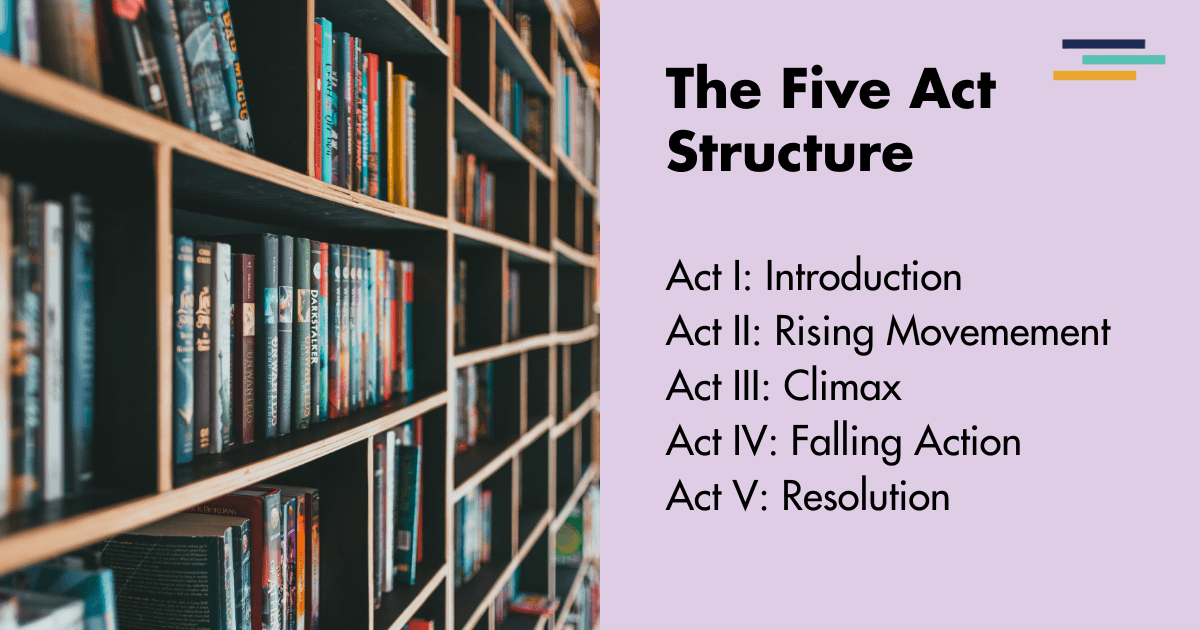
In the commonly used three act structure, Act I is 25%, Act II is 50%, and Act III is 75%. However, in the five-act structure Act I is 10%, Act II is 40%, Act III is 70%, Act IV is 85%, and Act V is 95%.
5 Act Structure Template
Act I: Introduction
The base of the triangle begins with exposition, the introduction to the characters, the world building, and the main conflict of the story.
Characters and their relationships with one another are slowly introduced in the early scenes without overwhelming the reader with too many new characters and names in a single scene.
In the beginning is also where the story’s world is introduced. Introducing important recurring settings in the beginning along with the world’s culture, economics, social structure, language, and more. The trick to avoid the dreaded “info dumping” is to weave all these introductions with conflict and action.
No matter what genre you are writing in, the conflict begins at a lower state than it reaches at the height of your story. Even if your story begins with death, the death should be less immediate or less related to your main character than at the most intense moment of your story towards the end. But even in a much more low-key story, the hints of what the conflict will become and stakes for your protagonist to achieve their goals should be there.
The first act does a lot of the heavy lifting, while hooking your reader into your story. The first act ends with what Freytag called the exciting moment, or what is more commonly called in the writing community, and in Fictionary, as the inciting incident. The first plot point of your story brings the first act to a close.
Act II: Rising Movement
The modern term for this section is rising action, and while the action is increasing during this section, what Freytag meant was rising movement because this is the act where conflict is increasing, and the protagonist is making lots of mistakes but learning from their mistakes as well.
Act II is the crucible for firing your protagonist and heating them up to prepare them for change. These are the progressive complications that build the tension. Also, important backstory that shows the protagonist’s motivations should be introduced here. The entirety of the cast should be introduced by the end of Act II, both helpers and hinderers (or at least foreshadowed).
Act II ends with another plot point where they leave behind everything they know for a new adventure, whether external or internal. In Fictionary this would be plot point 1, where the protagonist reluctantly accepts the story goal.
Act III: Climax
This act is the shortest of them all, often a single scene or a sequence of scenes that create a single chapter.
In modern vernacular, climax means the culmination of the action. However, Freytag saw it as a turning point. If your protagonist has been headed uphill with everything going fairly well, then they will now be on a downhill. If things have been going poorly for them in the first half, they will now improve.
Some call this the false victory or false defeat because the true outcome won’t be known until closer to the end of the story, otherwise, the story is over. So, this is where things go differently than expected and they begin a whole new journey.
This is a reflection point of where not only the story changes, but the character changes too. Again, not completely, but significantly. They are a different person and cannot go back to who they were at the beginning of the story. Though they’ve yet to become the person they will be at the end, they are on their way.
The climax is also a place where the theme can really shine and the reader comes to understand what the story is truly about. Consider foreshadowing the ending here with a hint of the outcome. Tension and conflict are high but it could be either external or internal depending on the genre. In Fictionary, Freytag’s climax is called the middle plot point.
Act IV: Falling Action
The second half of the story mirrors the first half of the story. Freytag called the first half “play” and the second half “counterplay.” Again, if things went well in the first half, they will go badly here and vice versa. The protagonist must readjust to their new story world.
The falling action is like an out-of-control boulder rolling downhill towards the inevitable crash between the protagonist and the story goal. Things should be moving quickly, though there are still lots of obstacles in the protagonist’s way. Tension is rising and new questions are raised. This section ends with the plot point called “the force of the final suspense.”
It’s the moment where a possibility towards a reversal is hinted at. This gives the reader that last moment of doubt that the protagonist will be ready to take on the story goal when the time comes. And it is also when the protagonist, themselves, doubts they can make it and may try to go back to who they used to be or quit the story goal. But they cannot.
Some call it “the dark night of the soul.” In Fictionary, it is called plot point two.
Act V: Resolution
The catastrophe is the final plot point where the protagonist resolves the story’s conflict. The protagonist has finally realized how they need to change and faces the story problem. In Fictionary, this is where the climax scene takes place. This mirrors the inciting incident from Act I.
In the resolution all loose ends are tied up, subplots, reactions, and the new normal world the characters live in. This mirrors the exposition of Act I. Answer all the questions raised in the story, unless this is part of a series, in which you can leave a few smaller questions hanging.
Act V ends with the denouement, or closing image, which shows how the character has changed from the very first scene. This last scene mirrors the first scene, or opening image of your story.
Act V is where the theme is strongly stressed and sometimes deliberately spelled out. This is the last moment for the author to tell the reader what it is they wanted them to learn—the moral of the story. This can be a happy ever after, or a final bloody ending, or perhaps a bittersweet twist that leaves the reader with a sense of irony. The characters can reflect on what they’ve learned and how their futures look.
Five Act Structure Examples
Before we dive into some examples of the five act structure, be aware that there are spoilers, so if you haven’t read one of the books, skip to the next one.
Harry Potter and the Sorcerer’s Stone by J.K. Rowling
Act I- Opening Image: Voldemort has somehow been defeated by Harry, who is placed as a baby by Dumbledore at his Uncle Vernon’s house.
Exposition: The reader is introduced into a world of magic where cats turn into people and motorbikes can fly and Harry Potter, the baby, is an orphan. Next, they are introduced to the Dursley household and how Harry has been treated these last ten years. And there are more hints of magic at work.
Inciting Incident: The first Hogwarts letter arrives, but Harry is not allowed to read it.
Act II- Rising movement: Harry learns that wizards exist and he is one of them. The reader follows as Hagrid takes Harry to meet Quirrell in the Leaky Cauldron, get a package from a Gringott’s vault, collect all his items in Diagon Alley, and meet Draco in Madam Maulkin’s Robes for All Occasions. He meets the Weasley’s at King’s Cross Station and many of the other students while on the train, including Hermoine.
Then Hogwarts and all the teachers are introduced as Harry is sorted into Gryffindor. Beyond the people and places the reader and Harry meet for the first time, there are hints to the coming conflicts, with the secret package, the pain in Harry’s scar, and the potion master that seems to hate Harry.
By the end of this act, all the pieces are on the board. And even though everything isn’t sunshine and roses, things have been going well for Harry. He has friends, is the youngest Quidditch seeker in a century, and does alright in his studies.
Act III- Climax: Harry and his friends have solved the riddle of the secret package, Nicolas Flamel, and the three-headed dog. The sorcerer’s stone is being hidden at Hogwarts. A false victory, but this is where things start to go wrong.
Act IV- Falling action: Hagrid wins a dragon egg and while they are smuggling the dragon out, they are caught, losing points for their house and winning the enmity of their peers. Harry goes from being popular to being infamous.
While serving detention in the forest, Harry is almost killed and discovers that Voldemort is hanging around the school, consuming unicorn blood, to wait for the moment where he can get the sorcerer’s stone. Harry has a choice between waiting until Voldemort comes to power and kills him, or he can try to stop Voldemort from ever getting the stone.
The force of the final suspense: The three go to report their suspicions to Dumbledore, but he is gone. This gives the reader doubt that Harry will face Voldemort on his own, as he goes to a teacher for help. But because Dumbledore is gone, Harry decides they must stop Snape themselves.
Act V- Catastrophe: Harry faces Quirrell alone, saving the stone, and defeating Voldemort for the time being.
Resolution: Harry is saved, magic is explained, and the stone will be destroyed, so it is no longer a target for Voldemort. Voldemort has gone back to being mostly spirit, Gryffindor ends up winning the cup, Harry is a hero again, and Harry returns home for the summer. But now he can threaten his cousin with magic, so his life has changed for the better.
Closing Image: After defeating Voldemort/Quirrell, Harry returns to his uncle Vernon’s house for the summer.
And Then There Were None by Agatha Christie
Act I- Opening image: Justice Wargrave on the train to Soldier Island and the handwritten letter he had that invited him there.
Exposition: The reader is introduced to all characters of the main cast, where they are currently in their lives, the letters/telegrams that invited them, and how they are getting to Soldier Island, along with what each of them knows about the island. The guests meet one another and the staff on the island and learn about their own rooms and the common areas of the house and outside.
Inciting Incident: The guests gather to hear accusations from their mysterious host and one of them dies from poison.
Act II- Rising movement: Each character’s backstory about the crime they have been accused of committing and the guilt they feel for what happened. When the supply boat doesn’t come, the guests discuss whether the two deaths are a coincidence or punishment from the accuser.
Act III- Climax: A storm hits as the discovery of a third body affirms that there is a murderer that they are trapped on the island with. The similarities to the murders as they occur line up with the poem and the destruction of the figurines on the dining room table at each death.
Act IV- Falling Action: Wargrave leads the search through everyone’s belongings and hides away anything that could be used as a weapon while they all stay together. The group is determined to survive, but no clues are found and people keep dying.
The force of the final suspense: With a trained judge in charge and sticking together, everyone feels like they’ll find and stop the killer. But then Wargrave is killed and everyone else dies one by one.
Act V- Catastrophe: Vera shoots Lombard, thinking him the killer, then hangs herself out of remorse for the death she was originally accused of.
Resolution: The police can’t make sense of the ten deaths. The lawyer is also dead. The people were told it was an experiment and to not respond to anything strange happening on the island. And no possibility of someone getting off the island because of the weather, until rescuers arrived.
Closing Image: The message in the bottle that is Wargrave’s confession to the murders, sent from Soldier Island.
Bridgerton: The Duke and I by Julia Quinn
Act I- Opening Image: Simon, the future duke’s birth, and his promise to be the opposite of his father.
Exposition: Introduction into the Bridgerton family, particularly Daphne, who is looking for a husband that she can feel affection for. Introduction into time period, the places in this world, the societal rules, etc.
Inciting Incident: At a ball, Daphne knocks out a annoying suitor/stalker after refusing his proposal again, in front of Simon.
Act II- Rising movement: Simon and Daphne set up a fake courtship with the reluctant agreement of her brother, Anthony. They spend time together to keep the marriage-minded people away from Simon and make Daphne look like an eligible marriage partner. Their friendship and attraction grows as they fight it, knowing they have opposite goals for marriage. They end up kissing, and Daphne’s reputation is at stake. Daphne stops a duel between Anthony and Simon. Simon and Daphne agree to marry even if Simon cannot have children.
Act III- Climax: Simon and Daphne marry.
Act IV- Falling Action: Daphne and Simon settle at Clyvedon and meet the staff. Daphne learns of Simon’s backstory with his father, his parent’s struggle to conceive, and his mother’s death. She realizes that Simon is purposely avoiding getting her pregnant because he chooses to not have children. This leads to conflict between the two.
The force of the final suspense: Daphne holds him down, leading to a possibility for pregnancy, but Simon resents it and moves out. So does Daphne, returning to London to be near her family.
Act V- Catastrophe: Daphne sends Simon a letter, believing herself pregnant. Simon confronts her after falling off her horse. Simon must decide if he wants to punish his father or choose love and family.
Resolution: Simon has made peace with Daphne, but then has to make peace with her family, specifically her three older brothers. Simon announces his love for Daphne and choice to have children. They read his father’s letters.
Closing Image: Daphne and Simon holding their fourth child, a newborn son and heir to the dukedom, while they chat lovingly.
Tips For Using the 5 Act Story Structure
Using a structure helps outline a strong story. Some people like more structure, like the five acts, and some people like less, like the three-act structure. It is up to the author to determine what works best for them.
Breaking your story up into more acts can help keep the focus on what needs to be happening in each section on character development, objects, theme, emotional impact of the places chosen, and more.
Using Freytag’s pyramid to visualize the five-act structure can help combat sagging middles, as the focus of the climax is at the middle of the story.
The five-act structure was written for more dramatic and tragic stories. Though it can work for comedies as well, where there is a happy ever after.
Knowing the expectations for a five-act story structure can keep your story focused and fulfill your reader’s expectations. The Fictionary story arc scenes are a part of those expectations.